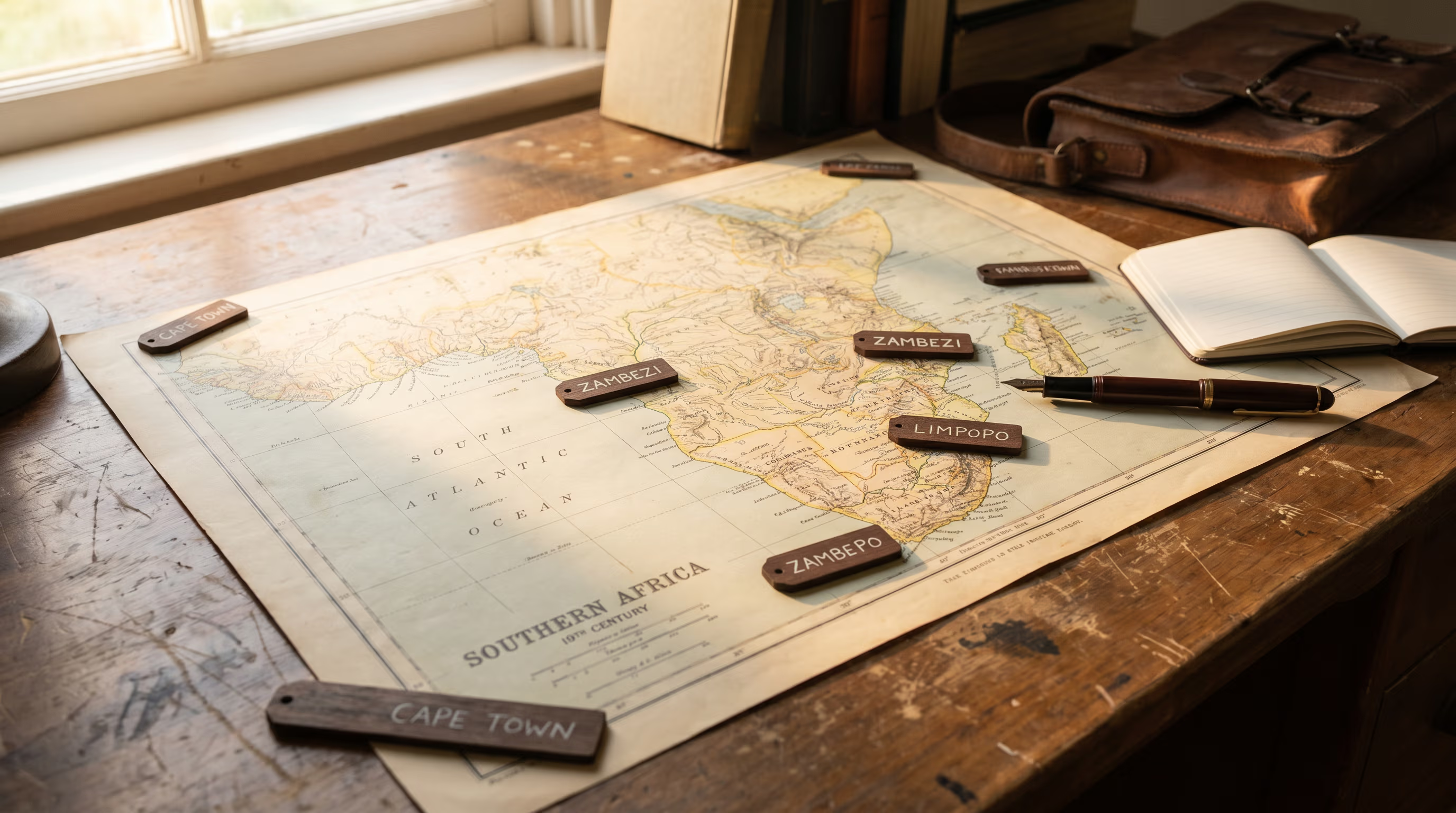
In October 2010, in a conference centre in the Japanese city of Nagoya, representatives from 196 countries signed an agreement that should have transformed the global cosmetic industry’s relationship with indigenous plants.
The Nagoya Protocol on Access to Genetic Resources and the Fair and Equitable Sharing of Benefits Arising from Their Utilization — to use its full and unwieldy formal name — is an annexe to the 1992 UN Convention on Biological Diversity. It is binding international law in the 130 countries that have ratified it. Its purpose is to ensure that when commercial industries use plants, animals, microorganisms, or traditional knowledge originating in a particular country, the country and its communities of origin receive a fair and equitable share of the benefits.
In practice, this means that when a multinational cosmetic brand sources, say, rooibos from South Africa for use in a face cream sold in Paris, that brand is legally required to have an Access and Benefit-Sharing (ABS) agreement in place with the South African government. Where indigenous traditional knowledge is involved — as it is for almost every Southern African botanical of cosmetic interest — the agreement also requires the prior informed consent of the relevant communities and a defined benefit-sharing arrangement with them.
This is the legal framework that has existed for sixteen years.
It is also the framework that, by some recent industry estimates, fewer than 30% of cosmetic brands using indigenous African botanicals are in full compliance with.
Why this matters
There is a particular history that the cosmetic industry’s use of indigenous plants sits inside.
In 1995, a small American company called Plant Genetic Resources successfully patented the use of turmeric for wound healing. Turmeric, which had been used for wound healing in Indian Ayurvedic medicine for several thousand years. The patent was eventually overturned, but only after the Indian Council of Scientific and Industrial Research mounted a multi-year, multi-million-rupee legal challenge — and only after the case became a global scandal that helped catalyse the very treaty we are discussing.
In 1997, a French laboratory patented the use of Quassia amara, a Surinamese tree, as a malaria treatment. The traditional knowledge of this use among the Wayana, Palikur, and Kreyol peoples of French Guiana was clearly documented in ethnobotanical literature, but the patent made no reference to it.
In 2009, a German cosmetics company, Schwabe Pharmaceuticals, lost a long legal challenge over its commercial use of Pelargonium sidoides, a South African geranium used by the Bambo and Khoisan peoples for centuries to treat respiratory infections. The patents were eventually revoked.
This is not ancient history. The pattern of Western commercial extraction of indigenous botanical knowledge — without consent, without compensation, without acknowledgement — is closer to the present than most consumers realise. The Nagoya Protocol is the international community’s response to it.
What compliance actually looks like
There are two pieces to a legitimate Nagoya-compliant cosmetic supply chain.
The first is access. Before a commercial entity can lawfully extract genetic resources from a Nagoya-party country, it must obtain a permit from that country’s competent national authority. In South Africa, this is the Department of Forestry, Fisheries and the Environment. In Namibia, the Ministry of Environment, Forestry and Tourism. The permit specifies what is being collected, in what quantity, for what commercial purpose, and over what period. Without the permit, the extraction is unlawful.
The second is benefit-sharing. The commercial entity must enter into a Mutually Agreed Terms (MAT) agreement with both the country and, where indigenous traditional knowledge is involved, the relevant communities. The MAT specifies what financial or non-financial benefits will flow back to the source country and communities. Financial benefits typically include either an upfront payment, a royalty on commercial revenue, or both. Non-financial benefits can include capacity-building support, technology transfer, scientific collaboration, or contributions to local biodiversity conservation.
For South African ingredients, there is also a domestic regulatory layer — the National Environmental Management: Biodiversity Act, or NEMBA — which extends and operationalises the Nagoya Protocol within South African borders. NEMBA requires a separate bioprospecting permit from the South African government for any commercial use of indigenous South African plants, with rooibos, honeybush, buchu, hoodia, and Pelargonium sidoides explicitly named in the regulations.
A genuine Nagoya/NEMBA compliant supply chain therefore requires: a national-level access permit, a community-level benefit-sharing agreement with the relevant indigenous knowledge holders, demonstrable royalty or payment flow, ongoing reporting to the national biodiversity authority, and (in the South African case) an explicit bioprospecting permit issued under NEMBA.
This is paperwork. It takes time. It takes lawyers. It takes a willingness to share commercial revenue with people who, in the prior model, would have received nothing. It is also the legal baseline.
The rooibos settlement
In 2019, after fifteen years of negotiation, the South African rooibos industry signed an industry-wide benefit-sharing agreement with the Khoisan peoples of South Africa.
The agreement, which is one of the most significant of its kind globally, requires every commercial rooibos producer in South Africa to pay 1.5% of farm-gate value into a benefit-sharing fund administered jointly by the National Khoi and San Council and the South African Rooibos Council. The fund supports community development projects in the historically Khoisan regions of the Western and Northern Cape, with an estimated annual flow of between 12 and 18 million rand.
The settlement is the first of its kind for an entire commodity. It is the result of a fifteen-year campaign by the Khoisan First Nations to have their traditional knowledge of rooibos — knowledge that goes back hundreds of years before the plant was first commercialised by European settlers in the early 20th century — formally recognised under both Nagoya and South African biodiversity law.
When we source rooibos from the Heiveld Co-op in the Cederberg, the 1.5% benefit-sharing levy is built into our wholesale price. It is not an optional ethics surcharge. It is what compliance with the law of the country we are sourcing from looks like, financially.
The honeybush situation
Honeybush is, at the time of writing, in a different position. It has been recognised as a traditional knowledge ingredient under NEMBA since 2014. A formal industry-wide benefit-sharing agreement, modelled on the rooibos settlement, has been in negotiation between the South African Honeybush Tea Association and the Khoisan Council since 2018. As of 2026, the agreement is still in draft form.
In the absence of an industry-wide agreement, individual honeybush producers are required to enter into bilateral benefit-sharing agreements directly with relevant traditional knowledge-holding communities. The producer we work with, the Cape Honeybush Tea Company, has such an agreement in place. We have requested and reviewed the documentation. The benefit-sharing component, in this case, is approximately 1.0% of farm-gate value, with the funds going to community development projects in the Eastern Cape.
This is the kind of detail that brands rarely disclose, because it is administratively complex and because the prevailing assumption is that consumers do not care. We are not certain consumers do care. We disclose it because it is the right way to talk about this work.
The marula case
The marula supply chain is structured slightly differently again. Marula is harvested across the borders between Namibia, South Africa, Botswana, and Mozambique. The Eudafano Women’s Cooperative — our supplier — operates primarily in northern Namibia and operates under a formal Nagoya-compliant ABS agreement with the Namibian government, dated 2012 and renewed in 2018.
The benefit-sharing structure is built into the cooperative’s business model rather than added on as a regulatory levy. Because the cooperative is owned by the women who harvest the marula — between 5,000 and 6,000 women across northern Namibia — the commercial revenue from the oil flows back to the harvesters as a function of the ownership structure, not as a separate ABS payment. The cooperative’s UEBT certification and Fair-Trade certification both audit and verify these flows annually.
This is, in many ways, a stronger structure than the levy-based model used for rooibos. The harvesters are not just receiving a percentage; they are receiving the full margin on their work, mediated through their own collective business.
The compliance gap
The reason for writing this essay is not to celebrate our own compliance. The reason is to point out that, sixteen years after Nagoya was signed, compliance across the cosmetic industry remains incomplete and uneven.
A 2022 report by the Union for Ethical Bio-Trade examined 50 randomly-selected cosmetic brands using indigenous African botanicals. Fewer than 30% had verifiable Nagoya/NEMBA documentation in place. A further 25% claimed compliance but could not produce supporting paperwork on request. The remaining 45% had either no documentation or documentation that did not meet the requirements.
This is not because Nagoya is hard to comply with. It is because compliance has historically been treated as an optional ethics layer rather than a legal baseline, and because the regulatory enforcement capacity in source countries is constrained.
The shift that needs to happen — the shift we are trying to be part of — is for compliance to be treated as it actually is: the legal floor, not the marketing ceiling.
What this looks like in practice for us
When we source any indigenous Southern African botanical, we ask the supplier for three pieces of documentation:
The first is the relevant national-level permit (NEMBA bioprospecting permit for South African ingredients, ABS permit for Namibian ingredients).
The second is the community-level benefit-sharing agreement, including the names of the recipient organisations and the benefit-sharing percentage.
The third is the most recent annual audit report from a recognised certifier — typically UEBT, Fair-Trade, or the relevant national authority.
If the supplier cannot produce all three, we do not source from them. This is a hard constraint, and it has narrowed our supplier list. It has not made us more expensive than we would otherwise have been; the compliance levy on rooibos and honeybush combined adds roughly R3 per finished unit across our launch range. It has, however, made us slower and pickier than we might have been if we had treated this as optional.
We think this is the right way to build the brand. We think the alternative — treating Nagoya as someone else’s problem — is increasingly indefensible. The legal landscape is tightening, the consumer awareness is growing slowly, and the older generation of indigenous knowledge holders are not getting any younger. The window in which Western cosmetic brands can plausibly continue to extract value from Southern African plants without compensating the communities of origin is closing, and it should close.
A reading list
If you want to go further on this:
- The text of the Nagoya Protocol is freely available on the UN Convention on Biological Diversity website.
- The South African NEMBA bioprospecting regulations are published by the Department of Forestry, Fisheries and the Environment.
- The Khoisan-Rooibos benefit-sharing agreement of 2019 is summarised on the South African Rooibos Council site.
- The UEBT (Union for Ethical BioTrade) publishes annual reports on industry compliance with biodiversity standards.
The work is real. The documentation is public. The history is not far behind us.
We would prefer not to repeat it.